


A temperature bath calibrator is a precision instrument used to check and calibrate thermometers, temperature probes, and other temperature sensors against a stable temperature reference. It creates a controlled liquid environment so the sensor under test and a reference thermometer can be exposed to nearly the same temperature. This comparison helps users assess measurement error and verify whether an instrument performs within its required tolerance.
Temperature measurement affects product quality, process control, laboratory testing, and regulatory compliance. In applications where even a small temperature deviation can influence results, a reliable calibration method is essential. A liquid bath is particularly useful when the sensor needs uniform temperature exposure over an immersed section, or when its shape and size are not suitable for a dry-block insert.
This guide explains how a temperature bath calibrator works, the main types and components, where it is used, and what to consider when selecting one for your calibration requirements.
- What Is a Temperature Bath Calibrator?
- How Does a Temperature Bath Calibrator Work?
- Key Components of a Temperature Bath Calibrator
- Types of Temperature Bath Calibrators
- Temperature Bath Calibrator vs. Dry-Block Calibrator
- Common Applications
- How to Choose the Right Temperature Bath Calibrator
- Good Practices for Reliable Calibration
- Frequently Asked Questions
- Conclusion
What Is a Temperature Bath Calibrator?
A temperature bath calibrator is a temperature calibration device that uses a liquid medium, such as water, silicone oil, or another suitable fluid, to create a controlled and relatively uniform temperature environment. The instrument being checked is immersed in the bath alongside a calibrated reference thermometer or temperature probe. Their readings are then compared after the bath has reached a stable condition.
Unlike a dry-block calibrator, which transfers heat through a metal insert with sensor wells, a bath calibrator uses a circulating liquid to provide thermal contact around the immersed portion of the sensor. This can be advantageous for probes with unusual shapes, different diameters, or multiple sensing points that need to be exposed to a common temperature environment.
The bath does not automatically determine whether a sensor is accurate. Instead, it provides a controlled temperature source for a comparison process. The result depends on factors such as the reference thermometer, bath stability and uniformity, immersion depth, sensor response time, and the calibration procedure.
How Does a Temperature Bath Calibrator Work?
A temperature bath calibrator works by bringing the sensor under test and a reference thermometer into a liquid bath whose temperature can be adjusted and maintained at a selected set point. The controller regulates heating, cooling, or both, while a circulation system helps reduce temperature differences within the working area.
- Prepare the bath: Select a suitable bath fluid and check that the vessel is clean and filled to the recommended operating level.
- Set the target temperature: Enter the calibration temperature required by the test procedure. Allow the bath to approach the set point.
- Position the sensors: Place the reference thermometer and the sensor under test in the working area, observing the recommended immersion depth and spacing.
- Allow the temperature to stabilize: Wait until the bath and the sensors have reached thermal equilibrium. The required time varies with the bath, sensor construction, and temperature change.
- Compare the readings: Record the reference value and the test instrument reading at the same stable condition. Repeat at the required calibration points.
- Evaluate the result: Calculate the deviation and compare it with the instrument's specified tolerance or the applicable acceptance criteria.
For a meaningful comparison, the reference thermometer should have suitable calibration status and uncertainty for the task. Users should also consider the bath's temperature stability and uniformity rather than relying only on the set-point display.
Key Components of a Temperature Bath Calibrator
A temperature bath calibrator combines several systems to create and maintain a controlled liquid temperature. The exact design varies by model, but the main components generally include the following:
1. Bath Vessel
The bath vessel holds the working fluid and provides the space in which the reference thermometer and sensors are positioned. Its capacity and working-area dimensions determine how many probes can be calibrated together and what sensor sizes can be accommodated.
2. Heating and Cooling System
The heating system raises the liquid temperature, while a cooling system lowers it when the application requires temperatures below ambient or faster temperature transitions. Some models provide heating only; others combine heating and refrigeration to cover a wider operating range.
3. Temperature Controller
The controller monitors the bath temperature and regulates the heating or cooling output to maintain the selected set point. Control performance, sensor feedback, and tuning all influence how steadily the bath operates.
4. Circulation or Stirring System
A circulation pump or stirrer moves the liquid through the bath to reduce temperature gradients. Effective circulation helps create a more uniform working zone, although the actual uniformity should be confirmed from the manufacturer's specifications and the calibration setup.
5. Display and Operating Interface
The display typically shows the set temperature and measured bath temperature. Depending on the model, it may also provide operating status, control settings, alarms, or communication functions.
6. Working Fluid
The liquid medium transfers heat between the bath and the immersed sensors. Water may be suitable for some moderate-temperature applications, while silicone oils or other specialized fluids may be selected for different temperature ranges. Fluid selection must follow the manufacturer's recommendations and take account of viscosity, flash point, chemical compatibility, and safe handling requirements.
Types of Temperature Bath Calibrators
Temperature bath calibrators are available in different configurations to meet laboratory, production, and field requirements. The most suitable type depends on the required temperature range, working volume, portability, stability, and calibration workload.
Portable Temperature Bath Calibrators
Portable models are designed for users who need to perform calibration outside a fixed laboratory. Their compact construction can make them easier to transport between production areas, maintenance locations, and service sites. Before selecting a portable unit, check its operating range, power requirements, bath capacity, and the time needed to reach a stable temperature.
Laboratory Temperature Bath Calibrators
Laboratory models are intended for controlled calibration environments where repeatability, stability, and a suitable working volume are important. They may support a wider selection of reference probes and test sensors, depending on the design. These systems are commonly used by calibration laboratories, research facilities, and quality departments.
Industrial Temperature Bath Calibrators
Industrial models are selected for regular use in manufacturing and process-maintenance environments. Their design may prioritize durability, practical operation, and compatibility with the plant's calibration workflow. Buyers should verify that the equipment is appropriate for the site's ambient conditions, operating schedule, and safety requirements.
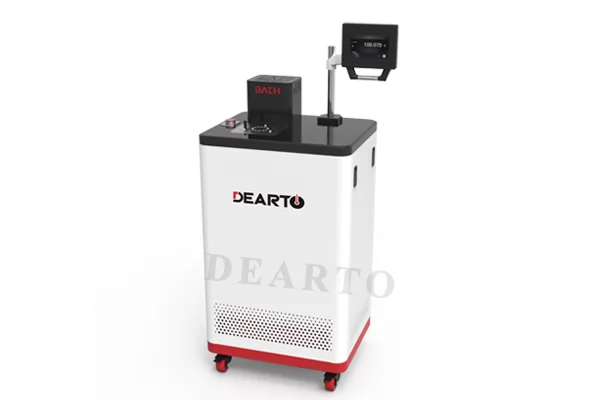
Liquid baths can provide thermal contact around immersed probes. The selected oil must be compatible with the required temperature range and operating conditions.
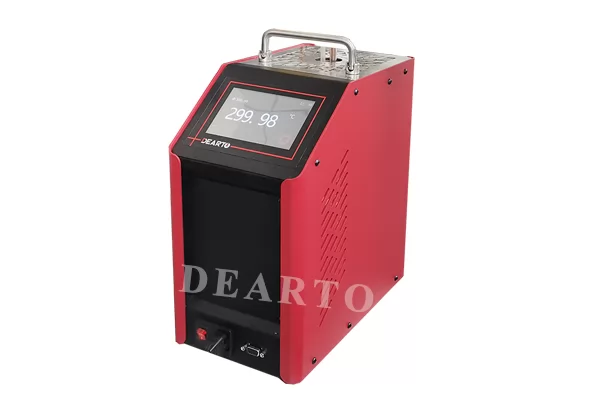
Dry-block calibrators use a heated or cooled metal insert with sensor wells instead of a liquid bath. They can be convenient for compatible probe sizes and field work.
Temperature Bath Calibrator vs. Dry-Block Calibrator
Both bath calibrators and dry-block calibrators are used as temperature sources for checking temperature sensors, but they transfer heat in different ways. A bath uses a liquid medium, while a dry block uses a solid metal insert with one or more sensor wells.
| Comparison Point | Temperature Bath Calibrator | Dry-Block Calibrator |
|---|---|---|
| Heat-transfer medium | Liquid working fluid | Metal insert or block |
| Sensor contact | Liquid surrounds the immersed section of the sensor | Sensor is inserted into a suitably sized well |
| Probe compatibility | Can accommodate a range of probe shapes and diameters within the bath's working area | Depends on insert-hole dimensions and sensor fit |
| Handling | Requires attention to fluid selection, cleanliness, and safe handling | Usually avoids handling bath liquid |
| Typical consideration | Useful when liquid immersion and a shared temperature environment are needed | Useful when portability and convenient insertion of compatible probes are priorities |
Neither design is universally better. A bath calibrator may be preferable for probes that are difficult to fit into standard wells, while a dry-block calibrator may be more convenient for routine checks with compatible probe dimensions. The decision should be based on the sensor design, required uncertainty, operating range, and calibration procedure.
Common Applications of Temperature Bath Calibrators
Temperature bath calibrators are used wherever temperature sensors need to be checked against a known reference. Common application areas include:
- Calibration laboratories: Comparing thermometers, resistance temperature detectors (RTDs), thermocouples, and other temperature probes at defined test points.
- Pharmaceutical production: Supporting temperature measurement checks for equipment and processes where documented temperature control is important.
- Food and beverage processing: Checking temperature sensors used in heating, cooling, storage, and production operations.
- Chemical and petrochemical plants: Verifying instruments used to monitor process temperatures, subject to the sensor and bath's suitable operating range.
- Manufacturing and quality assurance: Supporting routine instrument verification and maintenance programs.
- Research and testing: Providing a controlled temperature environment for laboratory measurement and experimental work.
The calibration points, acceptance limits, and documentation requirements should be defined by the user's quality system, applicable standards, and process requirements.
How to Choose the Right Temperature Bath Calibrator
Choosing a temperature bath calibrator involves more than checking its maximum and minimum temperature. Consider the following factors to make sure the instrument fits the sensors, calibration procedure, and working environment.
1. Required Temperature Range
List the temperatures at which your sensors need to be calibrated, including the lowest and highest points. Select a bath whose specified operating range covers those points with an appropriate margin. Also confirm that the recommended working fluid is suitable throughout the required range.
2. Temperature Stability and Uniformity
Stability describes how much the bath temperature changes over time at a given location. Uniformity describes the temperature differences between locations within the working area. Both affect comparison results. Review the manufacturer's stated performance conditions and determine whether they match your intended use.
3. Working Area and Bath Capacity
Check the usable bath dimensions, immersion depth, and capacity. The bath should accommodate the reference thermometer and the sensors under test without crowding or interfering with circulation. If you calibrate several probes together, consider the number and arrangement of sensors required in a typical run.
4. Sensor Compatibility
Identify the sensor types, probe diameters, shapes, sheath materials, and insertion lengths you need to calibrate. A liquid bath can be flexible for different probe geometries, but the sensor materials must be compatible with the bath fluid and the operating temperature.
5. Heating and Cooling Performance
Consider whether your work requires heating only or both heating and cooling. Check the time needed to reach target temperatures, the cooling method, and the recovery time after changing set points. These factors influence daily throughput, especially when calibration involves multiple temperature points.
6. Reference Thermometer and Measurement Uncertainty
The reference thermometer is a central part of the calibration setup. Its range, calibration status, resolution, and uncertainty should be appropriate for the tolerance being evaluated. The complete measurement uncertainty also depends on the bath, sensor positioning, readout, repeatability, and calibration method.
7. Safety, Maintenance, and Operating Cost
Review fluid replacement and cleaning requirements, ventilation needs, electrical requirements, and safe operating procedures. For oil baths or other specialized fluids, check the relevant safety data and temperature limits. Consider ongoing fluid costs, maintenance access, and operator training as part of the total ownership cost.
Good Practices for Reliable Temperature Calibration
Even a capable temperature bath calibrator can produce unreliable results if the setup or procedure is inconsistent. The following practices help improve repeatability and support traceable calibration work:
- Use a suitable reference: Select a reference thermometer with valid calibration documentation and uncertainty appropriate to the test.
- Follow immersion requirements: Insert each probe to the recommended depth and avoid positioning it too close to the vessel wall or bottom.
- Allow sufficient stabilization time: Wait for both the bath and the sensors to reach a stable condition before recording readings.
- Keep the bath fluid in good condition: Check fluid level, cleanliness, and suitability. Replace or maintain the fluid according to the manufacturer's instructions.
- Avoid unnecessary disturbance: Opening the bath, moving probes, or changing the sensor arrangement can affect thermal equilibrium.
- Record the calibration conditions: Document set points, reference readings, test readings, stabilization criteria, sensor identification, and relevant environmental conditions.
- Follow safety instructions: Use appropriate protective equipment and observe the fluid's temperature limits and handling precautions.
For formal calibration, use a documented procedure that defines the test points, stabilization criteria, calculation method, uncertainty evaluation, and acceptance criteria. A consistent process makes results easier to compare over time.
Frequently Asked Questions
1. What is the main purpose of a temperature bath calibrator?
Its main purpose is to provide a controlled liquid temperature environment for comparing temperature sensors with a calibrated reference thermometer. This helps users determine whether the sensors meet their specified accuracy or tolerance requirements.
2. What liquid is used in a temperature bath calibrator?
The fluid depends on the required temperature range and the bath design. Water, silicone oil, and other suitable heat-transfer fluids may be used. Always follow the manufacturer's recommendations and check the fluid's temperature limits, viscosity, compatibility, and safety information.
3. Can a temperature bath calibrator be used for thermocouples and RTDs?
Yes. Temperature baths are commonly used to compare thermocouples, RTDs, and other compatible temperature probes. The sensor's construction, immersion requirements, operating range, and the calibration procedure must be considered.
4. What is the difference between bath stability and uniformity?
Stability refers to temperature variation over time at a particular point in the bath. Uniformity refers to temperature differences between different positions in the working area. Both are important when evaluating the performance of a calibration setup.
5. Is a temperature bath calibrator better than a dry-block calibrator?
Not in every situation. A bath can be useful for probes with different shapes and sizes because the liquid surrounds the immersed section. A dry-block unit can be easier to transport and operate when the probes fit its inserts. The best choice depends on the application and required measurement performance.
6. How often should a temperature bath calibrator be checked?
The interval depends on usage frequency, operating conditions, quality-system requirements, and the manufacturer's recommendations. Establish a documented verification or calibration schedule based on risk and actual performance history.
Conclusion
A temperature bath calibrator provides a controlled liquid environment for comparing temperature sensors with a reference thermometer, helping users verify measurement performance across defined temperature points. When selecting a system, pay close attention to temperature range, stability, uniformity, bath capacity, fluid compatibility, sensor dimensions, and the uncertainty required by your calibration process.
Choosing the right calibration equipment and following a consistent procedure can improve measurement confidence, support quality control, and help maintain reliable temperature data. To learn more about temperature calibration equipment and available solutions, visit Dearto's official website and contact the team to discuss your application requirements.